Locked Out of Your Office After Hours in Arlington TX?
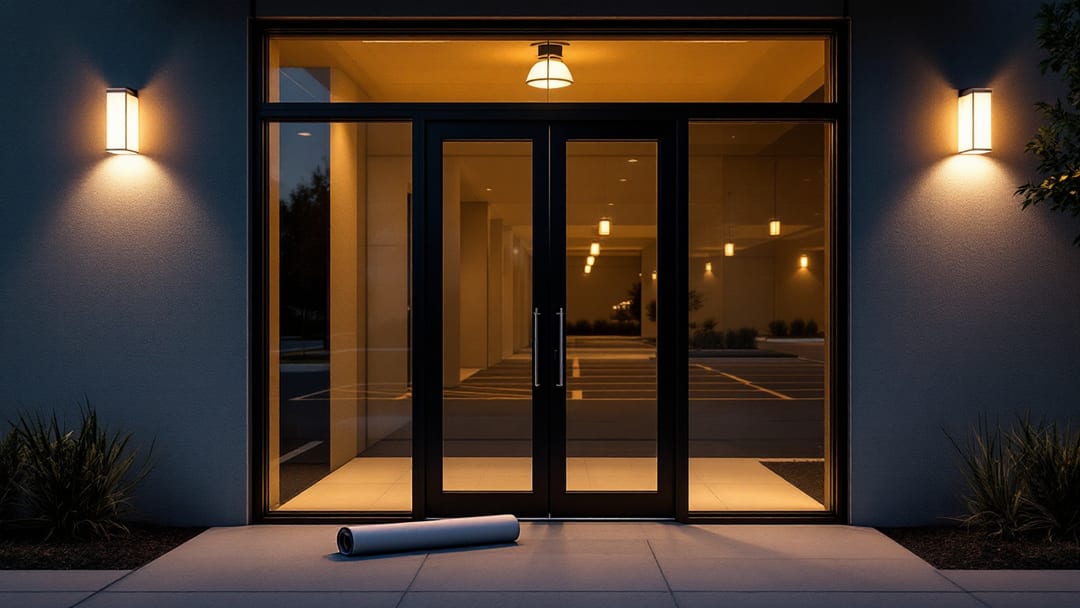
As of July 2026, an after-hours commercial lockout in Arlington typically runs $125 to $300 depending on the hardware and the hour, and Arlington TX Locksmith responds to office, storefront, and warehouse lockouts across the city — call or text (817) 330-5762. A business lockout is genuinely a different job from a house lockout: the hardware is heavier, the doors are built to resist exactly what we are being asked to do, and someone has to establish they are entitled to be let in. This guide covers what an after-hours commercial call actually involves, what it costs, who can authorize it, and the handful of changes that stop this from being a recurring line item.
Why commercial lockouts are harder than residential ones
Three differences, and all of them affect your bill.
The hardware is built for abuse. A typical Arlington office suite uses a mortise lock, a storefront deadlatch in an aluminum frame, or a lever set on a fire-rated door — not the knob-and-deadbolt combination on a house. Add panic hardware on rear exits and you have doors engineered to survive daily commercial traffic and to resist forced entry. That resistance does not switch off because you are the one who belongs inside.
Authorization is a real step. At a house, the person standing at the door usually has a driver's license with that address on it. At a business, the person calling might be an owner, a manager, an employee, a contractor, or someone who should not be there at all. Sorting that out is part of the job rather than a formality.
The timing is almost always inconvenient. Commercial lockouts cluster at the edges of the day — an early opener at 5:30 a.m. who cannot get in before a delivery, or a manager doing a closing count at 11 p.m. who pulled a door shut behind them. Those are the hours the call happens, and pricing reflects a visit outside normal windows.
What it costs in Arlington
| Scenario | Typical Cost | Typical Time |
|---|---|---|
| Storefront deadlatch, business hours | $95 – $175 | 15 – 30 min |
| Mortise or lever set, business hours | $110 – $200 | 20 – 40 min |
| After-hours or weekend opening | $125 – $300 | Same, plus travel |
| Panic hardware / rear exit door | $150 – $300 | 30 – 60 min |
| Lock replacement if opening is not viable | Add hardware cost | 45 – 90 min |
| Same-visit rekey while we are there | $20 – $35 per cylinder | Add 10 min each |
Those reflect realistic 2026 Dallas–Fort Worth rates. That last row is worth noticing: if you are already paying for a call-out, adding a rekey costs a fraction of what a separate appointment would. Businesses that have been meaning to change locks since someone left months ago often just get it done while the van is on site.
You should be quoted before anyone is dispatched, and a quote that changes materially on arrival is the classic bait-and-switch pattern the Federal Trade Commission warns about. Our guide to avoiding locksmith scams in Arlington covers the specific signs — no company name when answering, cash only, unmarked vehicles, and reluctance to put a number in writing.
Who can authorize entry — and what to have ready
This is where commercial and residential genuinely diverge, and it is the part that delays calls when people are not ready for it.
We need to establish two things: that you are who you say you are, and that you have authority over the space we are being asked to open.
Documentation that normally satisfies this:
- Government-issued photo ID
- The lease or rental agreement naming you or your business
- Business formation paperwork or a state registration listing you
- A utility bill for the premises in the business name
- A payroll record or letter on company letterhead from an owner or officer
An employee badge on its own generally is not enough, because a badge proves employment rather than authority to open the building. If you are a manager rather than an owner, the fastest path is a phone call to the owner while we are en route so authorization can be confirmed directly. Tell us that on the initial call and we will plan for it rather than discovering it at the door.
Multi-tenant buildings need a special mention. If your suite is inside a larger building, you can generally authorize work on your own suite door but not on the lobby, corridor, or exterior entrance — those belong to the landlord. Every property manager should have an after-hours contact for exactly this, and if yours does not, that is a gap worth raising at your next lease conversation. Say up front which door is the problem and we will tell you honestly whether we can help or whether you need the building contact first.
Non-destructive versus replacement
Most commercial doors open without damage. Some do not, and you deserve to know the difference before work starts rather than after.
Usually non-destructive: storefront deadlatches, standard mortise locks, commercial lever sets, most panic bar exterior trim, and cylindrical locks on interior doors.
Sometimes requires hardware replacement: high-security cylinders with restricted keyways designed specifically to resist manipulation, certain electrified locks and access-control hardware that has failed closed, and cylinders already damaged by a prior attempt — including a previous locksmith's.
That third case is more common than it should be. A door that someone has already tried to open with the wrong tools is harder and more expensive than the same door untouched. If a key has snapped off in a commercial cylinder, stop, and let our broken key extraction service remove it — a snapped blade driven deeper by improvisation frequently turns a $95 extraction into a hardware replacement. Our lock repair service covers cylinders damaged before we arrive.
Small businesses are advised to plan for interruptions before they happen, because unplanned downtime is one of the most preventable costs a small operation carries. — U.S. Small Business Administration
That framing is exactly right for lockouts. The Small Business Administration treats access continuity as part of ordinary business preparedness rather than as an emergency topic, and the fixes are cheap relative to a single lost morning of trading.
Stopping it from happening again
Four changes, in rough order of how much they help.
Move off physical keys for daily entry. A keypad or credential-based lock means a forgotten key is not an event at all. Codes can be issued per person and revoked instantly when someone leaves, without touching the hardware. Our guide to keypad access control for Arlington small businesses covers what this costs and what to look for.
Keep a documented off-site spare. Not hidden outside the building — that is a burglary aid, not a contingency. A labeled spare set held by an owner at home, or in a locked cabinet at a second location, solves most lockouts for free.
Maintain a key log. Vehicle, door, cylinder, who holds a key, when it was issued, when it came back. It takes minutes to maintain and answers the only question that matters when someone resigns: what is unaccounted for? Our guide to master key systems and storefront hardware covers how to structure keying so one lost key does not compromise the entire building.
Rekey on staff turnover, not eventually. An uncollected key is an open door. Rekeying an existing cylinder is inexpensive and can be scheduled outside business hours, and our emergency rekey service handles same-day cases where a key went missing under concerning circumstances.
A typical after-hours call in Arlington
Picture a small clinic in an office park off the Highway 360 corridor. The office manager stays late on a Friday to finish billing, steps out to move a car, and the suite door — a mortise lock on a self-closing frame — latches behind them. Laptop, phone charger, and the day's paperwork are all inside. The building's exterior door is still open, so this is a suite-door problem rather than a landlord problem, which is the easier of the two.
On the call we confirm the situation, quote an after-hours range, and ask what documentation is available. The manager is not the owner but has the lease PDF on their phone and can reach the practice owner, who confirms authorization by phone while our van is en route. That thirty-second call is the entire authorization step.
On-site, the mortise lock opens non-destructively in about twenty-five minutes. While there, the manager asks about the back door, which has been sticking for weeks — a strike plate alignment issue that gets adjusted on the spot before it becomes its own after-hours call. Total time under an hour, and the clinic opens normally on Monday.
The follow-up conversation is the valuable one: the practice adds a keypad on the suite door the following month, and a labeled spare now lives at the owner's house instead of nowhere at all.
Frequently Asked Questions
How much does a commercial lockout cost in Arlington TX after hours? Expect roughly $125–$300 for an after-hours commercial opening, above the typical residential range because the hardware is heavier and the visit falls outside normal service windows. Mortise locks, panic hardware and high-security cylinders take longer than a residential knob, and that time is reflected in the price.
Who can authorize a locksmith to open a business door? Someone who can document authority over that space — an owner, an officer, or a manager named on the lease. Expect to show identification plus something tying you to the business, such as the lease, a utility bill, business formation paperwork, or a payroll document. An employee badge alone usually is not enough on its own.
Can a locksmith open a door with a panic bar or mortise lock? Yes, in most cases non-destructively, though commercial hardware takes longer than residential. Panic bars, mortise locks and storefront deadlatches are all common and routine work. The genuine exceptions are high-security cylinders with restricted keyways and certain electrified openings, which may require the manufacturer or a hardware replacement.
What if I share a building and the landlord controls the entry door? Tell us before we dispatch. Common corridors, lobbies and exterior doors in a multi-tenant building are usually the landlord's responsibility, and a tenant generally cannot authorize work on them. We can open your own suite door with your authorization, but the building entrance needs the property manager or after-hours building contact.
Should I rekey after an employee leaves with a key? Yes, and quickly. A key that has left with a former employee is an open door until the cylinder changes, and it is one of the most common security gaps small businesses carry for months. Rekeying is far cheaper than replacing hardware and can usually be done outside business hours so nothing is disrupted.
How do I avoid ever being locked out again? The durable fixes are a keypad or credential-based lock so entry does not depend on a physical key, plus a documented spare-key policy with a labeled off-site set. A simple key log naming who holds what, updated when staff join or leave, prevents both lockouts and the quieter problem of untracked keys in circulation.
Locked out of your Arlington business? Call now
Arlington TX Locksmith handles commercial lockouts, rekeys, and hardware repair across Arlington and out through Grand Prairie, Mansfield, Kennedale, Pantego, and Dalworthington Gardens — from Downtown Arlington office suites to storefronts along the I-20 corridor. We are licensed and insured, we verify authorization on every commercial job, and we quote before we roll. Our emergency lockout service covers after-hours response.
Call or text (817) 330-5762 and tell us the door type, whether it is your suite or a shared building entrance, and who can authorize the work — those three details get an accurate quote and a faster arrival. You can also reach us through our contact page or read more about our mobile service.